
November 8, 2026
Nervous System Regulation Doesn't Mean Being Calm All the Time
We might have gotten nervous system regulation wrong this whole time. Learn why it's more about flexibility and capacity to return to baseline than feeling zen.
Written by Elaine Oyang · Photo by Kristina Pearl Photography · 10 min read
Nervous System Regulation Doesn't Mean Being Calm All the Time
Nervous system regulation is all the rage right now. Before that, it was self-care in the early 2020s. And before that, there was mindfulness in the 2010s.
To me, it all distills down to a similar longing of feeling comfortable, grounded, and happy, albeit in different packaging and marketing language.
It is the same story of learning how to handle hard things in life in the kindest way possible towards ourselves.
Somewhere along the way though, we've kind of lost the plot of "regulating our nervous system" to the internet.
I often see it misunderstood as being calm, nice, agreeable and happy all the time. It is often equated to not reacting to stress at all, and we start to think that getting angry, feeling upset, or losing our shit every now and then means we're doing something wrong. I know, because I've been there.
When calm becomes another thing to chase
When I first started practicing yoga, I thought it was about being calm all the time. I held on to that calm so tightly that anything that disrupted it felt like a problem. I'd get angry at my husband for being messy or loud, upset when my meditation was interrupted, and frustrated if I couldn't go to sleep early enough to wake up for my morning yoga practice.
I thought I was doing the right thing and being "yogic" by seeking calm, but I was also chasing something that wasn't meant to be permanent.
I was trying to create a carefully controlled environment in which calm was the default. In doing so, I was becoming less available for the relationships and ordinary disruptions that come with being human.
There is nothing wrong with wanting quiet and protecting our time. But unless we go on to become monks in temples and ashrams, the reality is that we live in life circumstances that will inevitably bring disturbances.
The goal isn't to chase and constantly protect that calm, but know how to return to it, again and again.
But before we dive deeper into what a "regulated" nervous system means, let's take ourselves back to Neuroscience 101.
What is the nervous system anyway, and what does it mean to regulate it?
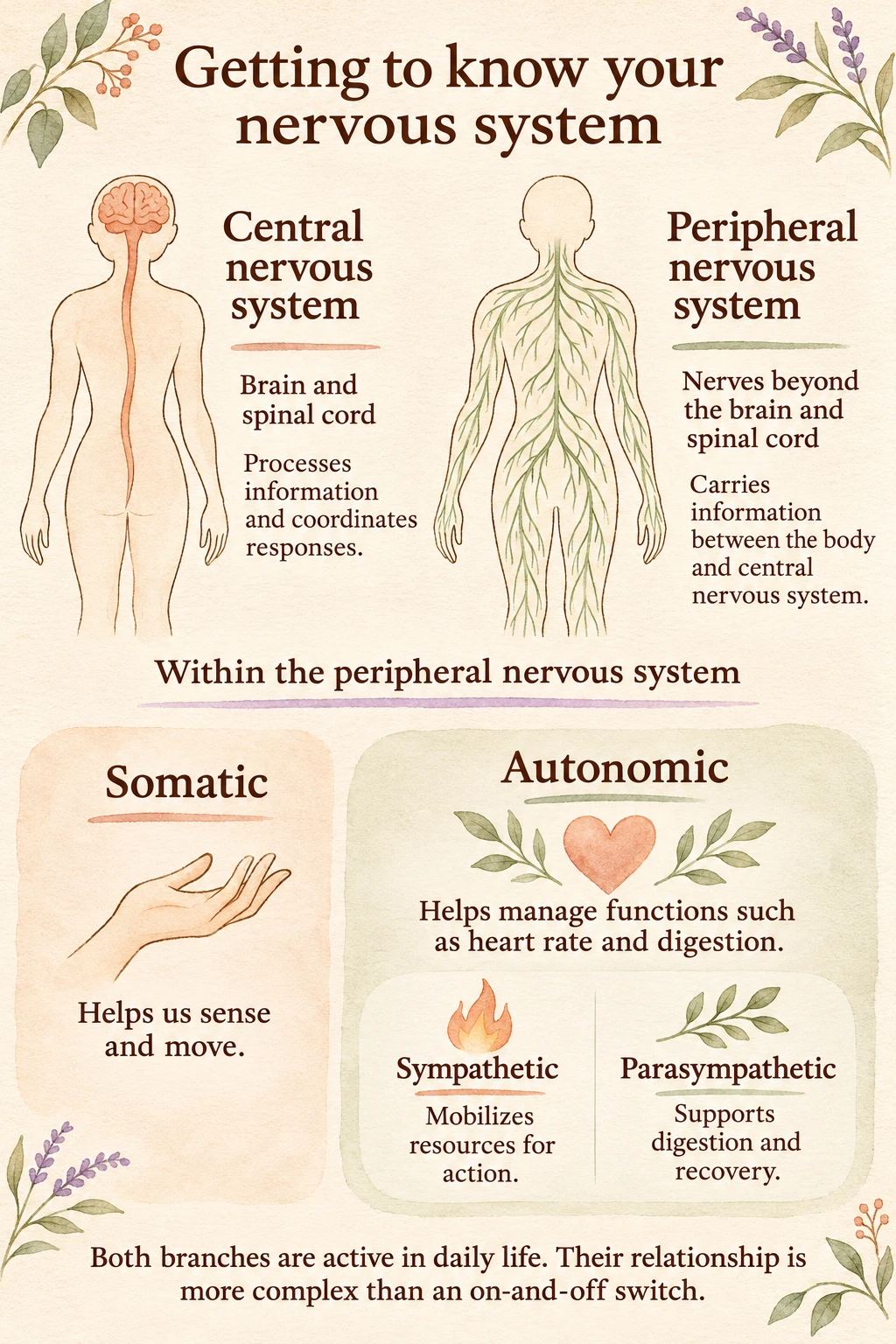
The nervous system is comprised of two parts:
- The Central Nervous System includes the brain and the spinal cord. It receives and processes information from within and outside the body and helps coordinate our responses.
- The Peripheral Nervous System is comprised of all neural structures located outside of the brain and the spinal cord. It serves as the messenger that carries information between the brain and the rest of the body. Within the Peripheral Nervous System, the somatic nervous system helps us sense and move our muscles, while the autonomic nervous system helps manage involuntary actions of the body such as organ functions (heart rate, digestion, breathing).
For this conversation, we'll focus on two subdivisions within the peripheral nervous system: the sympathetic and parasympathetic systems.
If you sift through some dusty memories of high school or college biology, you might remember the sympathetic nervous system as "fight or flight" and the parasympathetic nervous system as "rest and digest."
Sympathetic activity helps mobilize resources when we detect threat, handling the stress by "fighting" or "flighting." Whereas parasympathetic activity supports digestive functions, slows our heart and breathing rates, and overall helps keep our body at a neutral, relatively relaxed state.
We need both in our daily lives. Rather than on-off switches, the dynamic between the sympathetic and parasympathetic system is more like a dial or dimmer. In other words, one system doesn't simply shut off when the other steps in. Instead, they work together in continuous fluidity.
In wellness speak, when you hear someone wanting to "regulate" their nervous system, they usually refer to shifting out of fight-or-flight into rest-and-digest through various techniques, such as breath work, cold plunges, meditation, and specific movement practices.
The problem with "nervous system regulation" today is that many people misconstrue it to be being calm all the time — the misunderstanding I believed in my early years of meditation.
Regulation includes responding to stress and your feelings
A more helpful way to think about regulation is having the flexibility to respond to what is happening: shifting into appropriate sympathetic state responses when handling stress, then recovering and returning to the parasympathetic state when the stress has passed.
That might look like feeling slightly more anxious and physically tensed as a job deadline approaches. Your body is helping you meet the demand. It is doing what it's supposed to. Ideally, after you've delivered the project, there is an opportunity to recover, and that heightened response begins to settle.
Or it could look like feeling angry when you've been treated unfairly. But once you've healthily expressed your anger and taken the right measures to ensure that you don't get stepped over again, you discharge that anger.
Feeling stressed during a stressful event is not, by itself, evidence that something is wrong with you.
"You can be regulated and still lose your sh*t."
Unfortunately, in our modern society, many of our stressors are ongoing. We remain connected to work through our laptops and mobile phones at home. Pressure to outperform last year's metrics creates a demand that never seems to have an end in sight. Twenty-four hour news cycles continuously bring distressing news into our minds.
Wellness trends today like to recommend breath work, yoga, meditation, and cold plunges to downshift your nervous system from a heightened sympathetic state to the calm and cool parasympathetic state. Most of these practices, though helpful, might only be temporary.
When possible, supporting ourselves also means addressing the source of the stress and/or changing the conditions contributing to our stress.* That might involve setting a boundary, asking for help, changing an expectation, or acknowledging that something in our lives needs to change.
While nervous system regulating practices can help us weather the storms, we may also need to address the leaking roof for repair.
*I say this only when the environment and conditions for addressing them are safe. For cases of PTSD, sexual trauma, and mental health illnesses, more specialized professional care is needed.
Nervous system regulation is an ancient practice
Long before the trendy conversations today about nervous system regulation, ancient yoga traditions were already exploring and discussing the fluctuating dynamics of our minds.
And yes, they talked about regulation too, albeit in different terminology.
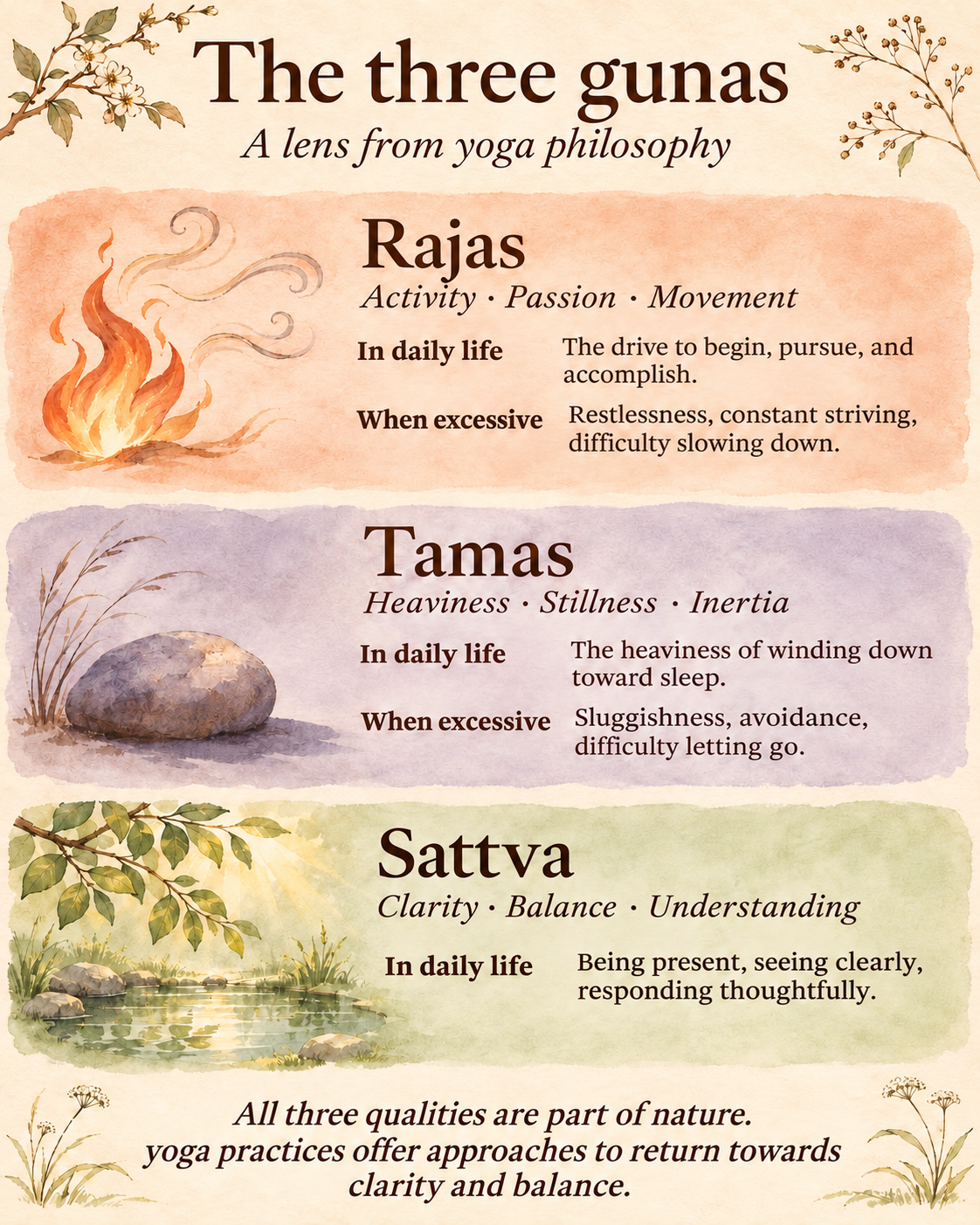
One philosophical lens comes from the Samkhya philosophy of the trigunas, used to describe the three fundamental energetic qualities of nature. These are rajas, tamas, and sattva.
The gunas provide a framework for understanding the interplay of activity, downshifting, and returning to balance and clarity.
Rajas: activity and drive
Rajas describes the state of activity, passion, and fiery pursuit. It is what fuels our desires and makes us take actions to fulfill the desires or goals. It can give us purpose and drive. Any activity we pursue, like hyping ourselves up for that morning run, bearing down to finish that project by its deadline, or firing up to deliver a perfect presentation pitch, requires us to be in a rajasic state.
However, when prolonged and not in control, we might continue to pursue something for the sake of keeping ourselves busy without clear, constructive goals, or double down in a heated argument that has become unproductive so that we can "win." It can easily cross the line over to feelings of restlessness, discontent, anxiety, burnout, and endlessly running on a hamster's wheel.
Tamas: rest and inertia
On the other side of rajas is tamas, a state of density, darkness, inactivity, and inertia. It is a required quality for us to relax at the end of the day, and eventually to fall asleep and stay asleep.
Yet when excessive within our body, it can result in lethargy, sluggishness, unhealthy attachments, possessiveness, and being avoidant. Excessive tamas looks like that lull from too much food and not enough activity in the winter, possessing and hoarding objects that have become clutter, or hanging on way too long in a relationship that has long expired or become unsupportive.
Sattva: clarity and balance
The third of the gunas is sattva, described as purity, wisdom, clarity, and balance. This is the state of contentment, often felt in deep states of meditation practices, but also during moments of quiet awe over a sunrise or sunset, the simple contentment of morning coffee or tea, and periods of blissful harmony during walks in nature. In this state, we are aware but not anxious; we are engaged in life but not entangled.
As a parent, I oftentimes enjoy the lingering sattvic joy while watching or engaging with my child in play. There is a genuine wholesomeness to it that is irreplaceable. If I were to suddenly shift into a rajasic state, I would be trying to come up with ways to recreate this idyllic sensation in a perfect setting. And if I were in a tamasic state, I would try to hold on to this exact moment and be unable to accept the next meltdown that's just around the corner.
Yoga teachings often encourage cultivating sattva, but they also recognize that all three qualities are part of nature. Activity and rest have their place, and human nature naturally shifts between these three states like a hummingbird flitting around in search of nectar. We will experience agitation, heaviness, and moments when our usual clarity feels muddied. But the yoga teachings and practices can help us find our way back toward sattva after those disturbances.
Is this starting to sound familiar? Remember how, many paragraphs ago, we discussed the nervous system needing to shift between sympathetic and parasympathetic states to appropriately respond to times of action, stress, and motivation, and times of rest and relaxation?
This capacity to return, again and again, is the similarity that I see with nervous system regulation. After responding appropriately to meet a demand (rajas-like activity), the body ideally has an opportunity to recover with support from parasympathetic activity (tamas-like activity) to return to a more balanced (sattvic) state.
Yet returning to sattva doesn't mean feeling at peace immediately or forever. It might mean recovering and gaining enough clarity to process the stressful demands that have occurred, so that we can better repair an overreaction, remedy an argument, set boundaries, and ultimately learn from the experiences.
Nervous system regulation flexibility
So what we've established at this point is that someone who is regulated doesn't always live in the ideal state. They are able to respond accordingly, and more importantly, eventually find their way back to home base.
Perhaps the more appropriate way to describe it is not nervous system regulation, but flexibility.
It might mean noticing that they're getting overwhelmed and asking for a pause. It might mean saying no, even when someone is disappointed. It might mean allowing themselves to feel angry enough to recognize that a boundary has been crossed, then deciding how they want to respond.
It can also mean recognizing when a stressful event or demand on their body has passed, and allowing themselves opportunities to rest and recover.
We cannot reliably judge someone's state by the cover either:
- They can be engaged in a lively conversation and feel present and at ease (sattva).
- They can sit perfectly still in meditation while their mind ruminates over an argument (rajas).
- They can appear calm and agreeable but feel afraid to voice what they need (tamas).
Regulation, or flexibility, isn't permanent either. Life circumstances are constantly evolving, and unprecedented demands on us may require us to keep noticing, practicing, and adapting.
Today, the external environment of my yoga practice is nowhere near the calm and quiet I was able to manufacture in my 20s. With a toddler asking questions every 10 seconds, my mind is constantly pulled away from deep internal awareness.
And yet, I return to my practice every morning, even if for a few minutes, because I know that by simply touching base with where my anchor is, I am more able to navigate my day with clarity and appropriate responses, instead of reactivity.
The question now is no longer, "How can I hold onto this calm as long as possible?" Instead, it is:
"How can I support myself in returning to this calm, my anchor, after the storms?"
If you'd like more reflections like this, along with practices to help you reconnect with yourself, I'd love to stay in touch.
Join my newsletterComments
Loading comments…
Leave a comment
Your email will not be published. All comments are reviewed before appearing.